

Medically Reviewed By
Dr. Kailash KothariMD Anesthesiology, Pain Medicine, FIAPM (Pain Medicine) · 30+ years experience
- No surgery required for many conditions
- Same-day procedures
- International training & advanced techniques
What is Vertebroplasty ?
Procedure overview
Vertebroplasty is a procedure in which a special medical-grade cement mixture is injected into a fractured vertebra. The vertebrae are the small bones that make up the spine. When they become fractured, you will often experience pain and a loss of mobility.When vertebroplasty is successful, the cement mixture injection stabilizes the vertebra and allows you to return to normal activity after a recovery period.
Reasons for the procedure
The main reason you would need a vertebroplasty is treat a fractured vertebra in your spine that’s causing pain and reduced function. Not all people with fractured vertebrae are candidates for a vertebroplasty, however.Your doctor may try other, more conservative methods of treating the pain first.
These are reasons that your doctor may consider a vertebroplasty for your fractured vertebra: traditional methods fail, severe/prolonged pain or immobility, or serious complications.
Risks of the procedure
The vertebroplasty procedure is generally well-tolerated, with a low risk for side effects. The complication rate of vertebroplasty is about 1% to 3%, and most of these complications are minor.
- Hemorrhaging
- Blood loss
- Rib or other surrounding bone fractures
- Fever
- Nerve root irritation
- Infection
- Flow of cement outside of the bone before it hardens
Before the procedure
Your doctor will probably order an X-ray, take a complete medical history, and do a physical exam to determine the precise location and true nature of your vertebra-related pain. MRI or CT scanning may also be used.
During the procedure
The procedure usually takes place in operation theater. Your doctor will use a continuous X-ray to guide the needle into your body. The doctor injects the needle into the fractured bone and slowly injects the cement mixture into the vertebra.
After the procedure
Once the procedure is complete and the cement has hardened, you will likely remain in an observation room for an additional 1 hour to 2 hours. You may experience pain relief almost immediately after the procedure, but for some people it takes up to 72 hours.
Procedure Images
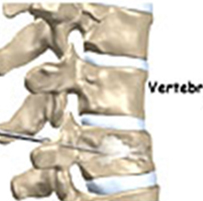
Who is Percutaneous Vertebroplasty for?
- Fractured vertebra causing pain and reduced function
- Severe or prolonged pain or immobility
- Failure of conservative methods
How Percutaneous Vertebroplasty is performed
- Continuous X-ray guidance
- Needle into fractured bone
- Cement mixture slowly injected into vertebra
- Patient lies flat while cement hardens
Before, during & after the procedure
Before: X-ray, medical history, physical exam and MRI/CT may be used to assess vertebra-related pain.
During: Procedure usually takes place in operation theater under sedation or anesthesia as needed.
After & recovery: Observation for 1-2 hours; many patients stand and walk with little or no pain.
Benefits of Percutaneous Vertebroplasty
- Stabilizes fractured vertebra
- May allow return to normal activity
- Pain relief may occur almost immediately or within 72 hours
Risks & possible side effects
- Hemorrhaging
- Blood loss
- Rib or surrounding bone fractures
- Fever
- Nerve root irritation
- Infection
- Cement leakage
Conditions treated with this procedure
Medical references
This page is informed by guidance from the following authoritative medical sources: