

Medically Reviewed By
Dr. Kailash KothariMD Anesthesiology, Pain Medicine, FIAPM (Pain Medicine) · 30+ years experience
- No surgery required for many conditions
- Same-day procedures
- International training & advanced techniques
Facet joints are joints between two vertebrae. They are present in entire spine. There are various causes which can produce facet joint pain. Some common ones are - bad posture, "whiplash" injuries, arthritis or degeneration of the spine.
When facet joints are inflamed, they can cause pain on one or both the sides of back, movement like bending backwards or forwards are painful. Sometimes pain may be referred to the gluteal, back side of thigh or calves.
These joints are supplied by nerves called "medial branch nerves".
How to diagnose if facet joint is cause of your back or neck pain?
Under X-ray control, a thin needle is inserted under local anaesthesia and the tip is placed in the facet joint or near the medial branch. A small amount of local anaesthetic is injected.
If Patient is relieved of his pain immediately post injection, we confirm that the pain is carried by medial branches. These patients will benefit for long term by radiofrequency ablation of medial branches.
This is the only test to tell the doctor the pain is coming from facet joint.
Once test is positive (i.e. you get more than 75% pain relief), radiofrequency ablation of medial branches will provide your lasting pain relief.
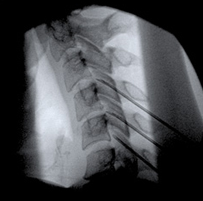
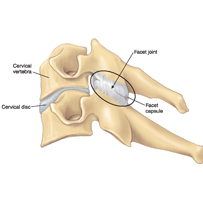
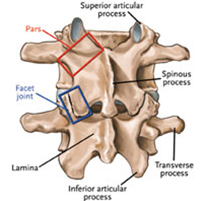
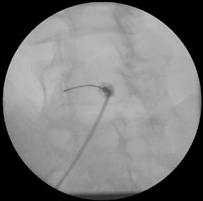
Radiofrequency ablation of Medial branches -
This procedure is same as diagnostic test. Special needles called RF cannula are placed near the medial branches under fluoroscopic control and RF current is applied. The nerve is heated and thus gets coagulated. This stops painful sensations from the Facet joints.
How long the effect lasts?
Usual benefit is seen anywhere from 6months to 18 months.
What if My pain comes back ?
Procedure can be repeated after the pain comes back.
Who is Facet Joint Injections for?
- Patients with suspected facet joint-related back or neck pain
- Pain that worsens with extension and rotation
- Chronic spine pain without disc herniation
- Patients being evaluated for radiofrequency ablation
How Facet Joint Injections is performed
- Patient is positioned prone on the table
- The target facet joint is identified under fluoroscopy
- Skin is cleaned and numbed with local anesthesia
- A needle is guided into the facet joint or to the medial branch nerve
- Contrast confirms correct placement
- Medication is injected
- The procedure is repeated for each affected level
Before, during & after the procedure
Before: Stop blood thinners as directed. Arrange transportation home. You may continue eating normally unless sedation is planned.
During: Takes 15-30 minutes. You will feel pressure during needle placement. The procedure is generally well-tolerated with local anesthesia.
After & recovery: Rest for the remainder of the day. Keep track of your pain levels — this information is crucial for treatment planning. Resume normal activities the next day.
Benefits of Facet Joint Injections
- Accurately diagnoses the source of spinal pain
- Provides therapeutic pain relief
- Guides further treatment (such as RFA)
- Minimally invasive
- Quick procedure with rapid recovery
- Can treat multiple levels in one session
Risks & possible side effects
- Temporary soreness at injection site
- Infection (very rare)
- Allergic reaction (very rare)
- Transient increase in pain
Conditions treated with this procedure
Frequently asked questions about Facet Joint Injections
Medical references
This page is informed by guidance from the following authoritative medical sources: